
As Hacettepe University, we are committed to providing quality and meaningful education within the scope of the Sustainable Development Goals, which is valid and applicable to all students. We share this commitment with the public on our sustainability website. Our commitment is set out below. You can also access the commitment on our website by clicking here.
Hacettepe University’s Commitment to the United Nations 2030 Agenda for Sustainable Development
The 2030 Agenda for Sustainable Development, which is a global agenda adopted by the Member States of the United Nations, looks to the future for the planet and humanity, and aims to eliminate poverty, protect our planet and ensure that all people live in peace and prosperity, while meeting the needs of today’s generations and setting goals to sustainably improve life for future generations. The 17 Sustainable Development Goals (SDGs) and their targets were adopted in September 2015 to be achieved by 2030. In this regard, a number of indicators were identified to measure and monitor the targets aimed for the future of the planet and humanity. The objective is to ensure better living conditions for all and leave a livable world to future generations while preserving the planet.
As of the adoption of the Agenda, the SDGs were also embraced by the Turkish State. They are monitored by the Presidency of Republic of Turkey, Presidency of Strategy and Budget. The monitoring of sustainable development indicators for our country is the responsibility of the Turkish Statistical Institute.
Universities play an important part in addressing critical global problems and achieving the SDGs. Universities have a responsibility to provide the necessary education and training to their students—who will be the leaders and innovators of future generations—that will allow them to comprehend the global challenges that the world is facing and the role they can play in overcoming these challenges. In terms of conducting research and training future investigative leaders, universities are in the front line for finding sustainable social, economic, environmental and technical solutions to global problems. Universities can lead innovation through their activities and set an example for other businesses and sectors. It is important for the future of the world in general, and of countries in particular, that all universities fulfill their responsibility in achieving the SDGs.
Hence, We, as Hacettepe University, would like to emphasize the importance of this issue by:
- Recognizing the enormous social, economic and environmental challenges facing the world,
- Recognizing that future development must be socially, economically and environmentally sustainable,
- Recognizing that the SDGs establish an agenda for the achievement of sustainable development by 2030,
- Recognizing that universities can play a crucial role in achieving a sustainable future through education, research and other activities.
Hacettepe University attaches great importance to providing qualified and meaningful education on the Sustainable Development Goals for all students. Our university aims to increase students’ participation in sustainability studies by preparing comprehensive course curricula and organizing seminars on this subject.
Sustainability Courses
Courses for the Sustainable Development Goals are given below.
| Name | Code |
| Introduction to Sustainability | SEC320 |
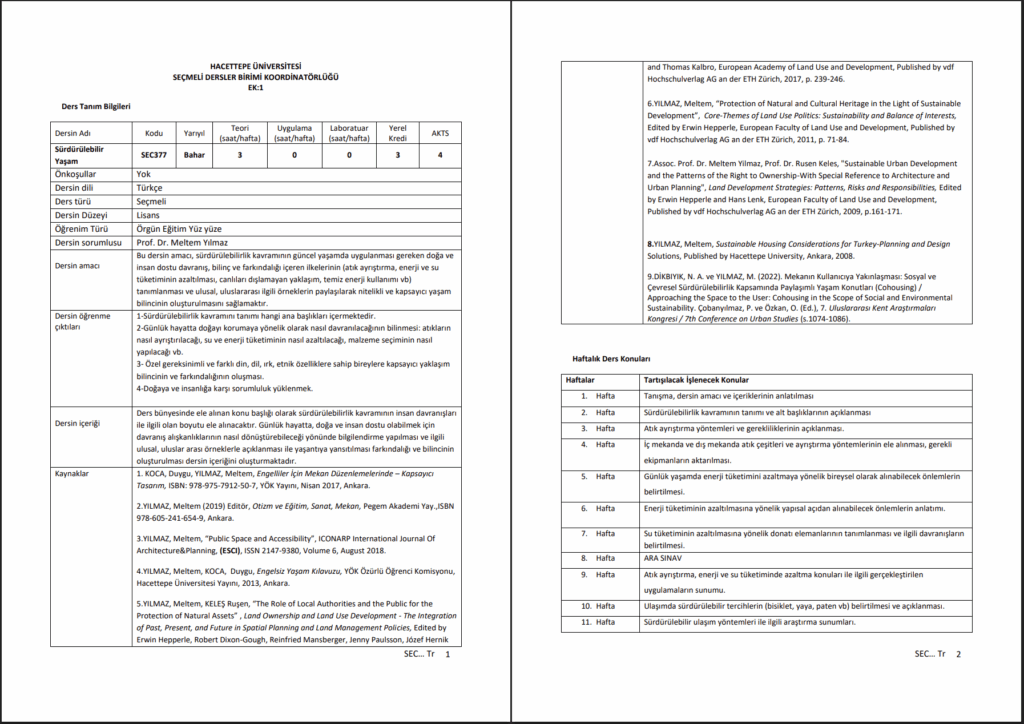
| Sustainable Living | SEC377 |
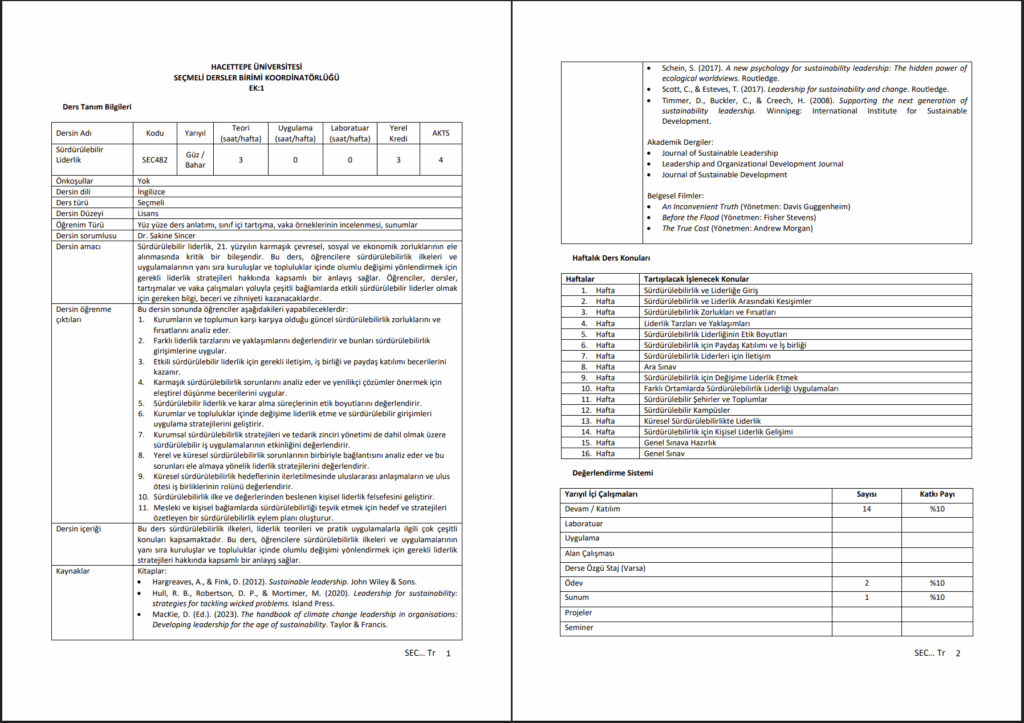
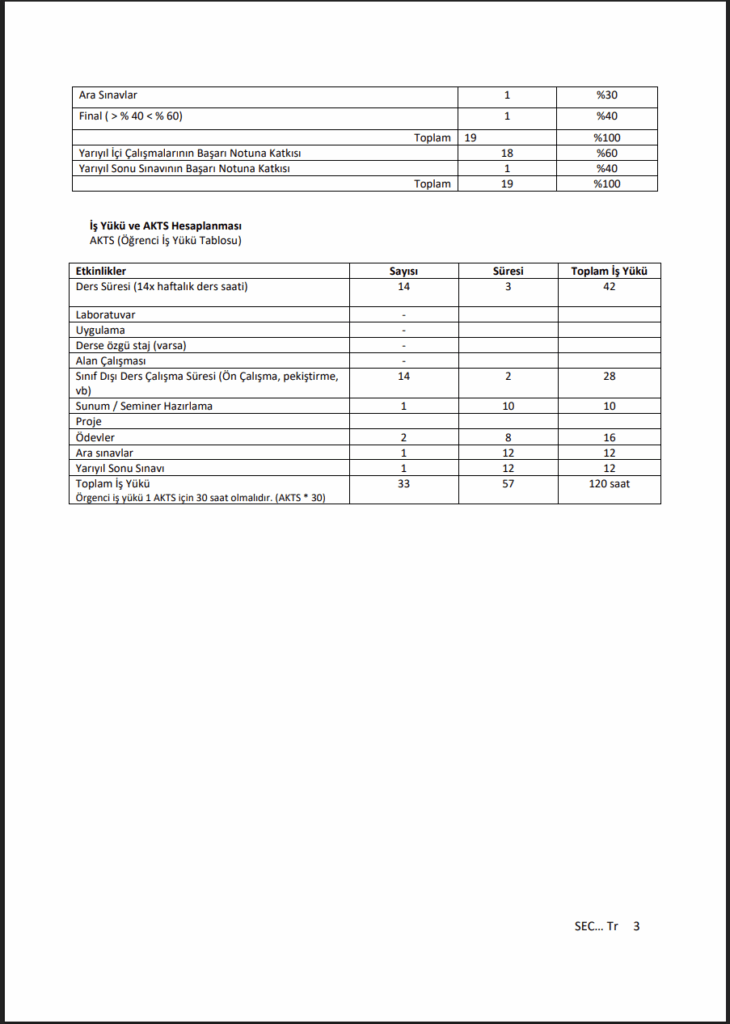
| Sustainable Leadership | SEC482 |
- Introduction to Sustainability

- Sustainable Living

- Sustainable Leadership
Sustainability Seminars
Below are the seminars organized on sustainability topics.
- Hacettepe University Zero Waste and Waste Management Applications
This event aims to showcase the university’s current practices in sustainable waste management and the progress it has achieved in this area. The presentation will define the principles of zero waste and discuss their importance in reducing environmental impact, along with the steps the university has taken within this framework. Policies implemented to achieve key objectives, such as waste reduction, material reuse, and increasing recycling rates, will be elaborated upon.
Dr. Dilara TÜFEKÇİOĞLU will present Hacettepe University’s plans and past implementations in waste management. Concrete efforts, such as campus-wide recycling programs and initiatives to reduce single-use plastics, will be shared, supported by data and results. Within this context, the university’s contributions to environmental sustainability, its current status, and its achievements will be discussed.
The event aims to provide insights into the university’s current position in this field and its ongoing projects. It will evaluate the implementation processes of the methods already adopted and their impact on the university community. The presentation will reflect Hacettepe University’s commitment to its zero-waste goals and its overall approach to waste management.

- Sustainability Seminars: “Net Zero Emission Targets and Sustainable Electricity Generation”
Prof. Dr. Merih Aydınalp Köksal is a faculty member in the Environmental Engineering department at Hacettepe University. Her research areas include modeling end-use energy consumption in residences, short- and long-term electricity demand forecasting, and analyzing the environmental impacts of electricity generation. Dr. Aydınalp Köksal received her bachelor’s degree from the Environmental Engineering department at Marmara University and her master’s degree from the Mechanical Engineering department at the same university. She obtained her Ph.D. from the Mechanical Engineering department at Dalhousie University in Halifax, Nova Scotia, Canada. Before joining Hacettepe University, Dr. Aydınalp Köksal worked as a senior analyst in the demand forecasting department at the energy consulting firm ITRON in Boston, Massachusetts, USA, where she contributed to the development of electricity and natural gas demand forecasting systems. During her doctoral studies at Dalhousie University, Dr. Aydınalp Köksal worked as a researcher at the Canadian Residential Energy End-use Data and Analysis Center, where she participated in projects on econometric and engineering modeling of residential end-use energy consumption.
In this talk, which will be held online under the Hacettepe University Sustainable Campuses Coordination on Monday, June 3, 2024, at 8:00 PM, Prof. Dr. Merih Aydınalp Köksal aims to examine current ecological issues through the lens of net zero emission targets and to highlight the potentials of sustainable electricity generation. The language of the seminar will be Turkish.

- Faculty of Architecture Architecture Talks: World Environment Day: “Is Sustainability Sustainable?”
Prof. Dr. Celal Abdi Güzer received his Bachelor’s degree from Middle East Technical University in 1982. He completed his master’s and doctoral studies at the same university and pursued doctoral work on architectural criticism at Newcastle Upon Tyne University in England, where he also taught courses. He currently teaches architectural criticism and leads project studios at Middle East Technical University. Güzer has numerous national and international publications focused on theory, criticism, and design related to contemporary architectural concepts and practices. He has held positions such as Deputy Head of Department, Assistant Dean, and Head of Department at METU and served as the president of the Architects Association 1927 for a term. Güzer has been a jury member in various competitions and has received numerous awards, including three first-place prizes. His projects are primarily conducted within Middle East Technical University, and he has numerous completed and ongoing urban and architectural projects. Among these, the MATPUM Research Center received the YEM award in 2008, and the Zeugma Museum received the Presidential Award in 2012. In 2013, he curated the International Antalya Architecture Biennial and organized the main exhibition themed “template.” Güzer was awarded the TSMD Jury Special Award in 2019 for his contributions to architecture. His research interests include architectural criticism, contemporary architectural practices and concepts, housing and mass housing, urban transformation, and sustainability.
Within the scope of World Environment Day, Mr. Güzer aims to critically examine sustainability and evaluate it from an architectural perspective in his online lecture organized by the Faculty of Architecture at Hacettepe University. The language of the conference is Turkish.

- Sustainability Seminars: “Towards Sustainable University Campuses: The Case of Beytepe Campus”
Prof. Dr. Meltem Yılmaz graduated from the Middle East Technical University, Faculty of Architecture, Department of Architecture in 1986 after completing her high school education at the Turkish Education Association Private High School. She completed her master’s degree on Historical Environments at Hacettepe University, Department of Interior Architecture and Environmental Design. She obtained her doctorate at Ankara University Faculty of Political Science Urban and Environmental Sciences, working on Property Rights and Sustainable Urbanization. Between 2013 and 2016, she worked as the Dean of Hacettepe University Faculty of Fine Arts before being the Dean of Hacettepe University Faculty of Architecture in 2020. Additionally, she has been the coordinator of Hacettepe University Sustainable Campuses Coordinatorship since 2022. She is a member of international professional organizations called Ekistics and the European Academy of Land Use. She is a member of the YÖK Disabled Student Commission. She works on Sustainable Architecture and Sustainable Urbanization. She has many national and international publications, proceedings and books on related subjects. She also has research and publications on the relationship between Autism and Space and accessibility.
In this speech, which will be held online under the Hacettepe University Sustainable Campuses Coordinatorship on Monday, June 10, 2024 at 20.00, Prof. Dr. Meltem Yılmaz aims to underline the importance of campuses in this regard by conveying the position of university campuses in current environmental problems and the opportunities they can offer through the example of Beytepe Campus. The language of the seminar is Turkish.

- Sustainability Seminars: “Sustainable Forest Ecosystems in the Era of Climate Change”
Çağatay Tavşanoğlu serves as a professor at the Faculty of Science at Hacettepe University, and he is the head of the Major Field of Ecology in the Biology Department. Tavşanoğlu received his undergraduate degree from the Faculty of Science Biology Department at Hacettepe University, and he completed his master’s and doctoral studies in the Major Field of Ecology at the same university. He has served as the president and board member of the Ecology and Evolutionary Biology Society, and he is a member of the Eurasian Dry Grassland Group and the British Ecology Society. Tavşanoğlu is also involved in various committees affiliated with Hacettepe University. He continues his research in life sciences, environmental biology, plant diversity, plant ecology, forest ecosystems, and forest fires. In his speech, to be held online on Thursday, May 16, 2024, at 20:00, organized by Hacettepe University’s Sustainable Campuses Coordinatorship, Mr. Tavşanoğlu aims to examine contemporary climate change conditions through the lens of forest ecosystems and sustainability concepts, and draw attention to the necessities in the relationship between the natural environment and humans. The seminar will be conducted in Turkish.

- Justice Approach for Transformative Education for Sustainable Development in Higher Education Institutions
This seminar aims to share theoretical and practical knowledge regarding the necessity of ‘Justice Approach’ in education for the transformation of higher education programs towards Sustainable Development. Following the overview of ‘Justice Approach in Education,’ the seminar will provide insights into the components and pedagogical dimensions of Justice Approach developed within the framework of the JustEd Project in the context of the UK. It will be concluded with sample activities for the integration of ‘Justice Approach’ into higher education programs.

- Sustainability Seminars: “Ecological Restoration and Sustainability in Literature”
Prof. Dr. Ufuk Özdağ is a faculty member of the Department of American Culture and Literature at Hacettepe University and the founding director of the university’s Soil Ethics Application and Research Center. Özdağ received her PhD in American Culture and Literature in 1995, her associate professorship in 2006, and her full professorship in 2015.
Özdağ’s main research areas are nature literature and ecocriticism, with interdisciplinary and comparative studies on the environment in literature. In addition to courses on 20th-century American culture and literature and environmental themes in literature, she teaches undergraduate and graduate courses on art theory and criticism, and the relationship between modern art and literature. Özdağ is the author of the books “Edebiyat ve Toprak Etiği: Amerikan Doğa Yazınında Leopold’cu Düşünce” (2005, 2017) and “Çevreci Eleştiriye Giriş: Doğa, Kültür, Edebiyat” (2014, 2017). She is also the co-editor of the books “The Future of Ecocriticism: New Horizons” (2011), “Environmental Crisis and Human Costs” (2015), “Anadolu Turnaları: Biyoloji, Kültür, Koruma” (2019), and “Nature v/s Culture” (2022). Özdağ is the translator of the seminal book of the modern environmental movement, “A Sand County Almanac,” and the co-translator of “Desert Solitaire.
Within the scope of the Hacettepe University Sustainable Campuses Coordination, in this online lecture to be held on Monday, May 27, 2024, at 8:00 PM, Mrs. Özdağ aims to shed light on contemporary ecological issues and highlight the reflections of ecological restoration and sustainability in literature through an interdisciplinary perspective and comparative studies. The seminar will be conducted in Turkish.
