
Hacettepe University attaches importance to strengthening inter-sectoral dialogue by bringing together representatives of different sectors such as the government, private sector, non-governmental organizations, and academia.
You can access the Hacettepe University 2024-2025 Sustainability Report here.

The conferences, collaborations and projects attended by Hacettepe University on sustainability are shown below.
Education and Hacettepe University Cooperation Protocol
With the cooperation protocol signed between Ankara Provincial Directorate of National Education and Hacettepe University, it is aimed to ensure cooperation and coordination between the parties in order to strengthen mutual institutional capacities in all areas deemed appropriate by the parties, especially in the areas determined as priority regarding the quality of education in educational institutions affiliated to the Ministry of National Education located within the provincial borders of Ankara.
Cooperation between institutions affiliated to the Ministry of National Education and higher education institutions serving in the field of education; It is an important strategic initiative to increase the quality of education in schools, as it will enable the development of mutual cooperation between these two levels of education, which are stakeholders, by sharing educational problems that arise at all levels.
There are kindergartens, kindergartens, primary schools and secondary schools affiliated to the Ministry of National Education on Hacettepe University campuses that university staff can benefit from.

Collaboration between Hacettepe University and Duke University
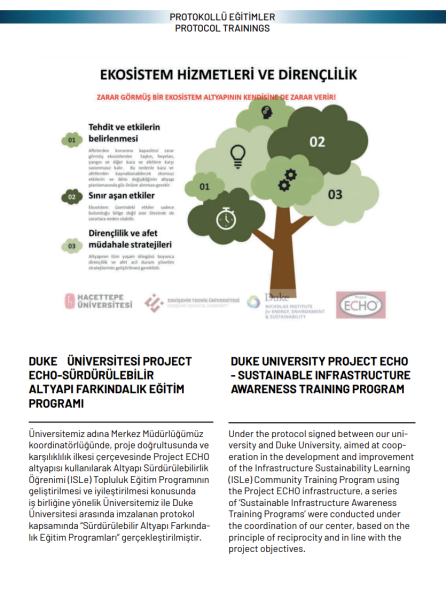
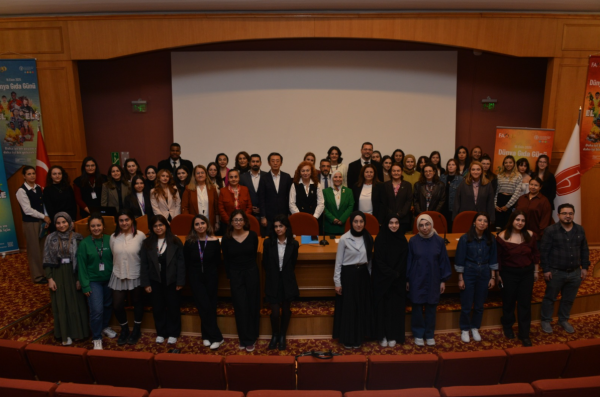
An academic cooperation protocol was signed between our university and Duke University on July 26, 2024 for the implementation of the learning model developed within the scope of the Infrastructure Sustainability Learning (ISLe) Initiative project (https://nicholasinstitute.duke.edu/project/infrastructure-sustainability-learning-isle-initiative) carried out by Duke University Nicholas Institute for Energy, Environment and Sustainability in Turkey.
The ISLe project, which aims to help experts and practitioners develop capacity for sustainable and resilient infrastructure by exchanging information and establishing solution-oriented collaboration, creates virtual communities of practice for sustainable infrastructure practitioners.
A sustainable infrastructure community of practice will be created using the Project ECHO model in line with a program designed in line with the United Nations Environment Program’s International Good Practice Principles for Sustainable Infrastructure under the leadership of Hacettepe University.
The main purpose of this program, which will be carried out in Turkey in cooperation with Hacettepe University Social Contribution Coordination and Lifelong Learning Center and with the participation of expert academics from other universities; To contribute to the construction of reconstructed infrastructures in line with sustainability principles by providing support to leaders, experts and practitioners carrying out reconstruction efforts in the regions affected by the February 6, 2023 earthquake.
A cooperation protocol was signed between Hacettepe University and the University of New Mexico
With the cooperation protocols signed between Hacettepe University and the University of New Mexico in June 2024, our university has earned the right to be the implementer of the ECHO Project in Turkey.
The “Project ECHO: Hacettepe University” project, which will be carried out under the coordination of our University’s Social Contribution Coordinatorship, is planned to provide case-based training in areas determined according to social needs and to create a community of practice in this way.
About the ECHO Project:
- The ECHO Institute within the University of New Mexico Health Sciences Center is a pioneering telementoring and distance education program designed to develop and increase the workforce.
- Its main purpose is to increase the capacity to provide best-practice treatment to underserved people all over the world by removing the monopoly of knowledge.
- ECHO programs were launched in 2003 with a focus on hepatitis-C treatment. Today, it is carried out with more than 1,200 partners and participants from approximately 200 countries worldwide.
- To date, more than 5 million people have attended ECHO sessions, and more than 500 peer-reviewed articles have been published proving the program’s effectiveness.
- Conservative estimates suggest that more than 200 million patients worldwide have benefited from this treatment model.
Project ECHO’s Core Approach:
- Moving knowledge: A structure that moves knowledge instead of people.
- Democracy of knowledge: Providing equal access to all by democratizing knowledge.
- Solving complex problems: Increasing access to best practices in solving complex problems worldwide.
- An environment where everyone teaches and learns: A dynamic learning community where everyone contributes.
- Real-time, peer-to-peer, and experiential learning: Instant feedback and opportunities to learn together.
- Collaborative problem-solving: Developing practical solutions to problems through interdisciplinary collaboration.
For detailed information about the project, you can visit https://projectecho.unm.edu.
- Hacettepe University Engages in International Collaboration through the ECHO Model
Project ECHO: The Nature-Based Solutions (NBS) Training Program for Sustainable Cities, jointly implemented by Hacettepe University and Eskişehir Technical University, was launched as part of the EU Erasmus+-funded EPD-Net (Ecological Planning and Design Network) Project.
Aiming to strengthen ecological planning approaches for disaster-resilient and sustainable cities, the program was successfully completed with high participation, based on the ECHO model.
Led by Eskişehir Technical University, the program was carried out in collaboration with Hacettepe University and international partners.

“Healthy Food for a Healthy Future” in Collaboration with Our University and FAO
The “Healthy Food for a Healthy Future” symposium was organized in collaboration with our university’s Social Responsibility Application and Research Center and the Food and Agriculture Organization of the United Nations (FAO), under the theme “Hand in Hand for a Better Life and a Better Future.”
During the symposium, speakers addressed various aspects of healthy food, access to food, and sustainability, emphasizing the need for collaboration across different disciplines and institutions, as well as the development of inclusive social policies related to these issues.
The symposium concluded with discussions highlighting that health and healthy nutrition are fundamental rights, the existence of global challenges, and the various determinants of nutrition. Participants also emphasized the importance of interdisciplinary approaches to addressing nutritional needs, the role of public policies, and the necessity of interdisciplinary initiatives targeting groups with specific conditions and needs.
Academic Cooperation Agreement between Hacettepe and Eastern Mediterranean University
An Academic Cooperation Agreement was signed between Hacettepe University and Eastern Mediterranean University, aiming to develop, strengthen and encourage relations.
The Academic Cooperation Agreement between our university and Eastern Mediterranean University (EMU), which aims to develop, strengthen and encourage relations, was signed by our Rector Prof. Dr. Mehmet Cahit Güran and EMU Rector Prof. Dr. Hasan Kılıç. Our Rector Prof. Dr. Mehmet Cahit Güran, Dean of our university’s Faculty of Communication Prof. Dr. Uğur Sadioğlu and EMU administrators attended the ceremony.
Prof. Dr. Mehmet Cahit Güran said the following in his speech at the signing ceremony: “As Hacettepe University, we want to strengthen our contact and relations with Eastern Mediterranean University and increase our cooperation. Hopefully, this step will be a first step that will lead to much better things in time. I would like to thank them again for their kind acceptance and hosting.”
EMU Rector Prof. Dr. Hasan Kılıç said, “I would like to express our happiness to see you here. Hacettepe University is one of the most successful educational institutions in Turkey. EMU is the only state university established by law in the TRNC. Therefore, the collaboration of these two institutions will allow us to set sail for new horizons. I attach great importance to this first step and we will move forward by setting new goals with this first step. We, as Eastern Mediterranean University, are very excited and proud to be in close institutional collaboration with you. I hope this signature will be auspicious and auspicious,” he said.
Within the scope of the Academic Cooperation Agreement, it is aimed to encourage joint research studies including academic and administrative staff exchange, to develop student exchange programs and/or programs providing dual diploma opportunities, to develop joint certificate and micro-qualification programs within the scope of lifelong learning services, to cooperate for publishing and/or cultural activities, to organize joint academic and scientific activities such as conferences, seminars, symposiums and congresses.

Incubation Center
Hacettepe Technopark Incubation Center provides services such as training, mentoring, consultancy, and networking that entrepreneurs need in their business establishment process. While free internet infrastructure and office facilities are provided to incubators, for which a very small rental fee is paid, they can also benefit from the kitchen, meeting rooms, and recreation areas that are open to common use. Many of our incubation companies, which we graduate after 36 months at most, grow and continue their activities by moving to offices within Hacettepe Technopark.
Hacettepe Technopark Incubation Center supports sustainability-oriented initiatives and projects. In addition, it collaborates with national and international organizations to develop solutions for sustainable development goals.
Of the companies within the Hacettepe Technopark, 62 of them operate within the 500 m2 Incubation Center area. In our incubation center, initiatives of academics and graduates of our university are also supported. The sectoral distribution of our incubators is Software 49%, Health 13%, Engineering 9%, Defense 5%, and Other 24%.
The Pre-Incubation Center, which is 176 m2 in size, has been serving since 2019, where entrepreneur candidates with business ideas in different fields such as software, electronics, games, cybersecurity, biotechnology are located. In our Pre-Incubation Center, 16 teams have the opportunity to work in the same environment 24 hours a day, 7 days a week, completely free of charge. There is also a prototyping depot. In the prototyping depot, candidates with a business idea can prototype their products with equipment as a three-dimensional printer, mini-CNC, mini lathe, etc. While there have been 32 teams in our pre-incubation center so far, 9 of them have been commercialized as graduates.
Contact:
Hacettepe Technopolis Technology Transfer Center
Universiteler Mah. 1596. Cad. Hacettepe Technopolis Sit.
6. Ar-Ge C Blok Apt. No: 6 C / 82 Cankaya / ANKARA
E-mail: info@hacettepeteknokent.com.tr
Tel: (312) 297 71 62 (pbx)