Hacettepe University carries out international collaborations and projects by evaluating and developing best practices for the Sustainable Development Goals and examining comparative approaches through international cooperation and research.
Policy REcommendations to Maximise the beneficial Impact of Unexplored Mobilities in and beyond the European Union (PREMIUM_EU)
Project duration: 01.04.2023 – 31.03.2026
Project coordinator: Prof. Dr. Alanur Çavlin
Project Summary
PREMIUM_EU will develop a Regional Policy Dashboard (RPD) for policy makers in vulnerable regions to help them formulate policies to use the potential of mobility to enhance regional inclusive growth and wellbeing. It is an evidence based tool, where policy makers are offered tailor-made selections of policies that reflect the mobility and regional development profiles of their region.
The dashboard contains three modules (sub-objectives), that contain state of the art EU-wide regional qualitative and quantitative information: a Mobility Module (MM), a Regional Development Effects Module (RDEM), and a Policy Module (PM).
The conditions that are favorable both for migrants and the receiving country need to be understood and policies should be implemented to foster the benefits of mobility.
- Beyond-EU mobility(moves from outside Europe into Europe), thereby focusing on the destination region,
- EU-mobility (international moves within Europe), and
- Internal mobilitywithin countries.
Mobility may be short or long term, with short term mobility encompassing stays at the destination of at least three months, such as seasonal mobility, student mobility and short-term work-related mobility.
Our team of partners:
- KNAW – Koninklijke Nederlandse Akademie van Wetenschappen(Royal Netherlands Academy of Sciences: Netherlands Interdisciplinary Demographic Institute NIDI),
- Hanzehogeschool Groningen / Hanze University of Applied Sciences Groningen,
- NR (Nordregio),
- Danmarks Statistik,
- OsloMet – Oslo Metropolitan University,
- Cracow University of Economics,
- The Centre for Demographic Study – Autonomous University of Barcelona,
- International Institute for Applied Systems Analysis (IIASA),
- Max Planck Institute for Demographic Research.
“Can remote regions in Europe benefit from global migration?”. Funded by EU Horizon, the project is aimed at exploring flows of migration, regional development and policy potentials.
You can access the details of the project PREMIUM_EU at premium-eu.org.
Roma Population Survey
The Roma Population Survey (Roma.Ar) project is carried out by Hacettepe University Institute of Population Studies and supported by TÜBİTAK 1001 – Scientific and Technological Research Projects Support Program and the United Nations Population Fund.
The objectives of the project are:
- To determine the level of integration and differentiation of the Roma population with the population of Turkey.
- To determine the change in the demographic characteristics of the Roma population.
- To determine why the Roma population is lagging behind in the demographic transformation process based on the demographic integration and differentiation level of this population and at what stage of this process it is on the basis of coping strategies.
- To contribute to the implementation of the Strategy Document for Roma Citizens prepared for 2023-2030 in the fields of education, employment, health, housing and social assistance by setting out policy priorities and strategies for the demographic integration of the Roma population with the population of Turkey, based on the demographic integration and differentiation level of the Roma population.


You can access the details of the project Roma.Ar at https://www.romaar.com/index.html.
International Best-Practice Development through Project ECHO and ISLe Collaboration
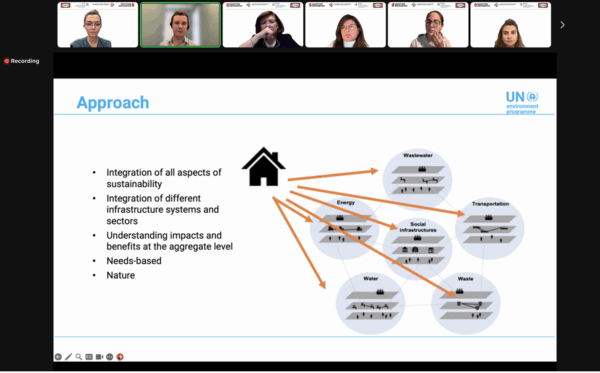
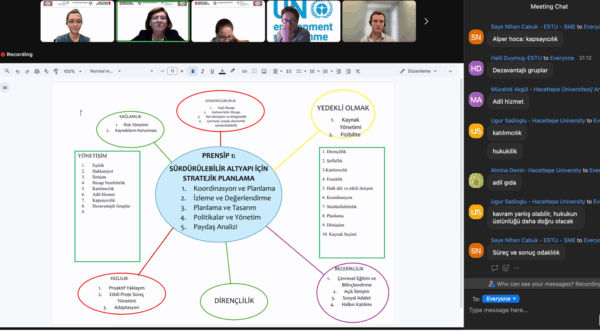
In line with the agreement signed between Hacettepe University and the University of New Mexico Health Sciences Center, Hacettepe University has been recognized as a ‘Project ECHO’ center. Within the framework of another cooperation protocol signed with Duke University, which is also a Project ECHO center, an education and community development project has been initiated for the sustainable reconstruction of the infrastructure in the earthquake region. The first session of the project titled ‘Infrastructure Sustainability Learning (ISLe) Community Training Program,’ which uses the Project ECHO infrastructure, was held on October 30, 2024, with 56 participants. In the first session, conducted under the title “Introduction to Sustainability Principles: The 10 Principles of the United Nations Environment Program and Strategic Planning,” the topics of “Introduction to the 10 Principles of the United Nations Environment Program,” “A Case Study on Strategic Planning in Post-Earthquake Reconstruction,” and “Creating a Mind Map Centered on Principle 1 (Strategic Planning)” were discussed. The program, conducted with the support of the Hacettepe University Lifelong Learning Center, is contributed by academics from Hacettepe University and Eskişehir Technical University, as well as experts from the United Nations Environment Program and the Disaster Risk Reduction Office. The expected beneficiaries of the program are postgraduate students and young professionals receiving education in this field. The first phase of this program, which will consist of six sessions, primarily aims to create a competent and sharing community with basic values and concepts in this field for the sustainable reconstruction of the infrastructure in Turkey after the earthquakes in 2023.